I'm Italian and I'm super happy with this.
The referendum that made nuclear energy illegal in Italy was held right after the accident of Chernobyl; people voted with their gut, not with their mind.
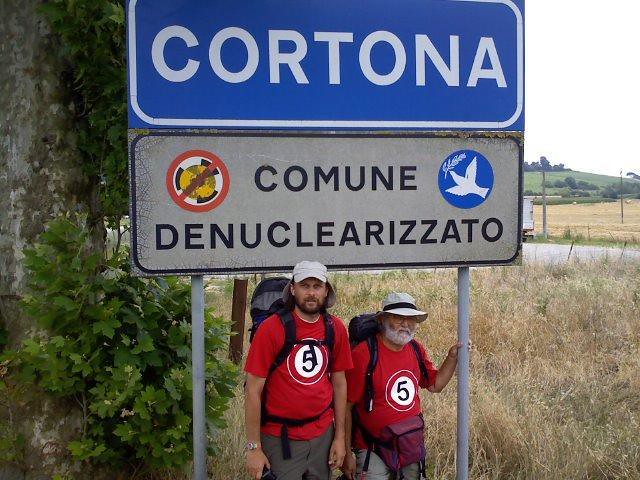
Curiously enough, some Italian town signs still have a small sub-sign reading "denuclearized municipality" (example: https://live.staticflickr.com/1421/712461235_e46a2c7db5_z.jp... )
As someone who thinks nuclear is both less efficient and much more expensive than renewable energies - would you mind sharing a bit why this makes you happy?
Since all plants in Italy are closed since the 90s won’t it take decades and billions of tax euros to get them back operational again?
It’s not either or, you need both. We haven’t solved energy storage so renewables can’t be the only source of energy. If you look at Value-Adjusted Levelized Cost of Electricity (VALCOE) it changes the calculation quite a bit. We have negative energy prices a few times per year in Europe as it is.
We’ve solved both. The research has moved on from VALCOE to whole system modeling. Including transmission, storage, backup, firming and modeling it hour by hour.
Studies are converging on renewable energy systems being cheaper in climates ranging from Australia to the Nordics:
Some recent ones:
Finland, 2025: nuclear scenarios 71–84% higher system cost; unrestricted least-cost optimization builds zero new nuclear. https://www.sciencedirect.com/science/article/pii/S036054422...
Denmark, 2026: system-level LCOE including storage, flexibility and system integration; renewables substantially cheaper than nuclear. https://www.sciencedirect.com/science/article/pii/S036054422...
Australia, CSIRO + AEMO GenCost 2025–26: whole-system modelling including transmission, storage and firming; renewables + storage remain the lowest-cost net-zero pathway. https://www.csiro.au/en/research/technology-space/energy/Ele...
I'm interested in why people think this is wrong, in case this is the reason for the downvotes.
Because what is true for these 3 countries is not true for all countries. There are counter-examples where nuclear is cheaper.
In most countries which don't have the advantages of Australia or Finland, you do need a mix as the OP was saying
What is Italy lacking? Sun? Wind?
Usually comes down to industry energy needs.
I didn't downvote but it's nonsense, nobody can sustain a winter with batteries and other storage.
I only checked the first paper and it doesn't seem talk about what would happen if a 3 weeks bad wind event would happen in winter, and a rough look at the figures makes me think it just wouldn't work at all. I didn't check the other papers.
And the proof is in the pudding anyways, if it's that cheap and feasible to do, well let's see who's doing it.
It is Simon Michaux that throws out the figure that you need 2TWH of storage to make it through he worse of Winter.
https://www.ecoshock.org/2024/02/why-renewables-cannot-power...
I think he points to a valid point but completely over plays his hand. Everyone that has argued these kinds of points have brought valid arguments but have completely under estimated the pace of change.
Do keep in mind that Michaux is a fan of being a little contrarian. He likes the attention it being to him.
He might be right, and him pointing to the issues may actually be something that helps us avoid these issues. Generally, knowing about a problem is a much better position than being slammed by something you didn't anticipate.
I tend to think long term we are going to a much lower energy world, that we made the mistake of building a world and our expectations to the paradigm of fossil fuels. But I also think that we are not going back to the stone age and that renewables will do better than the pessimists. Good chance we will hit a reasonable mid-ground even if it means living standards change, possibly a smaller, slower but more intentional world. It may be nice even if it means you can no longer get a slab of Coke for an hours wage.
About the last question, i don't think the old plants will play any part in this eventual return.
Fair - but using new (unproven) technology imo only increases the cost/time/risk overall?
The idea is to go to new-generation SMRs, not revive decades-old plants, which is actually impossible.
Aren’t SMRs essentially unproven? I think only Russia and China built some working facilities, and the rest is still under construction.
I mean anything could happen but seems like a long shot
In a nutshell, yes.
The argument is that small-scale nuclear reactors have been built for military and scientific applications so the tech is not especially novel.
What I think is unproven is whether SMRs can be built and run safely while being cost-effective to other forms of power.
I wouldn’t be surprised, for example, if it actually costs less to build and run one full-scale reactor than it does for multiple SMRs of the same output.
That doesn’t mean they won’t have a use.
Yeah, the issue isn't knowing how to build small reactors, it's whether you can do so with enough economy of scale and learning to make it cheaper than conventional nuclear.
And I personally have switched from bull to bear on that. I was rooting for NuScale but they're hitting the same thing as everyone else.
Meanwhile, battery storage has been on an insane cost reduction curve.
This is a key point to many things. Need to identify the difference between technically viable and economically viable.
It is the same argument I make for Starship. Technically, yeah it should work. The economics of of going to Mars, not so sure about that.
They are, but if the country has a law forbidding you from doing anything, things cannot move forward. If they'll not work, of course they won't be built. And large classic reactors are unlikely to be built either, even with this new law.
Gotcha - yea I think it’s a good idea to try out these things. I just hope it doesn’t become a ideological fight to make something work at any cost to fit a certain narrative (same goes for renewables of course)
Whether it's more expensive or not depends on how you measure "cost", and including intermittency and storage costs for renewables seems to favor Nuclear in many cases[1][2]. Based on real-world examples of countries that traded one for the other, like Germany, renewables look quite bad economically. I know there's a lot of hand waving about how this has to do with how electric auctions work, but this seems like a convenient excuse.
[1] https://www.sciencedirect.com/science/article/abs/pii/S03605...
[2] https://en.wikipedia.org/wiki/Cost_of_electricity_by_source#...
Thanks for sharing those links, very interesting.
I guess ultimately the nuclear vs renewables discussion is coloured a lot by feelings nowadays.
Resources like this help a lot to form a more nuanced understanding grounded in reality - but otoh I have to admit that a lot of this goes over my head - like even trying to understand how the economy works around this is mind boggling complex. I’ll need a deeper look to understand it better and build a more informed opinion tbh
You can also check the report from RTE (French grid operator) that models several scenarios and mentions this security of supply thing
https://analysesetdonnees.rte-france.com/en/publications/ene...
can you link to data to prove the economics are bad?
[dead]
It's cheaper if you stop caring about safety, right? In the USA it's now illegal for reactors to have adequate shielding - "as low as reasonably possible" is officially "woke"
"as low as reasonably possible" is a massive overkill.
US killing the linear no-threshold model is a good thing. LNT model assumes that absolutely no amount of radioactivity is safe, which is provably wrong.
It has nothing to do with safety if the model that required "as low as reasonably possible" is bullshit per se.
The maximum allowed annual radiation dose for US radiation workers is 50mSv/year. It's just 16x the global average background radiation. And that's the average. In reality it's more like 5x - 25x.
For cancer specifically we're seeing marginally increased risk at 100 mSv/year, but it doesn't really become worrying enough until we're at 300-500 mSv/year.
Two words: base load
And no you’re not solving it with a buffer (batteries or any kind of other energy storage for that matter)
Is there something unique to Italy that makes it an intractable problem? Where I live we've been able to shift a huge amount of our fossil fuels over to batteries in a relatively short time. It's nice that nuclear has power production 24/7 but it seems unnecessary when there's already a glut during the daytime
[dead]
The fact that nuclear is good at the easy part of power production is not a point in favor of nuclear. Grids are built to peak needs; any grid that can handle peak load can handle base load.
Can you use more than 2 words in your explanation next time? Reciting known talking points offers little.
[dead]
lol because nuclear reactors are so damn stable: https://www.euronews.com/2026/07/13/france-shuts-down-nuclea...
Six words: base load generation is economically obsolete
In my country, we also have a dormant nuclear plant because of Chernobyl and political reasons.
https://www.nytimes.com/2026/09/20/world/asia/philippines-ba...
Where in Italy would you put reactors?
https://maps.eu-risk.eucentre.it/map/european-seismic-risk-i...
Sardinia?
I think that there are plenty of blue areas on that map
Anywhere on this map. And you'd call it earthquake-proof, and when the next earthquake causes Fukushima 2, you just blame the contractors or something.
we had a referendum in 2011
Right after Fukushima