Personally i'm only using local LLMs that i can run on my 7 year old PC (that also has a GPU with 24GB VRAM because reasons :-P) so i'm not sure how much that experience matches what others are doing (though roughly speaking what i see people complain about Claude doing doesn't feel that different from what i see the local stuff doing, so i guess the drawbacks aren't scaled down as model sizes increase).
I'm not sure about 1x, 2x or 10x increase as these metrics are about code written but that isn't a productivity metric (something pretty much every half-decent programmer would agree with before LLMs - remember stories about Bill Gates saying that more LoCs being good for software is like more weight is good for airplanes or Bill Atkinson's story about adding -2000 LoCs to improve QuickDraw?).
But they can certainly help "get you going" faster in that if you're stuck on something (for whatever reason - including "that feels too much drudgery") or have issues starting something, you can have an LLM take a stab at it and it'll produce "something". Sometimes it is enough by itself, but more often than not it'll need tweaks (either directly or having the LLM do it). I got to make a bunch of things i couldn't convince myself to do - e.g. an image viewer that doesn't suck (based on my arbitrary judgement), a game database, a script to convert a git repository into static html pages that kinda look like GitHub, etc.
They can also help find (and sometimes fix) bugs or other "code smell" issues. They're not that great for exact results (without tool calling -and knowledge on how to use them effectively- at least) but when it comes to fuzzy / vague stuff like "check out this code <code dump here> can you spot any issues?" they always tend to find some stuff (even if it is hallucinations :-P but sometimes they find actual issues too or whatever hallucination they come up with reveals some actual issues with the code that you didn't spot by yourself). I've been dabbling with Rust recently and asked Qwen 3.6 35B-A3B to judge my code and it wrote "6.5/10, will compile but looks like C in Rust" :-P.
The article says:
> Never write READMEs, docstrings, or comments. I will write those myself later. And yes, I really mean this.
And sure, LLMs aren't that great about those (i do let them leave whatever comments they want though and remove them later myself - i think those comments help during the generation/prediction - basically how they "think", kinda like the reasoning phase), but they can be very good at things like "here is the code, here is the documentation for it, spot discrepancies" (i had Devstral Small 2 do this and it hallucinated a few discrepancies but also found real stuff i missed in the docs).
I've tried to use Devstral Small 2 for some API docs but found it'd sometimes make assumptions about what function do or how. One approach that might work, but i haven't tried yet, is to write the "guide" myself, then have the LLM write the function docs using both the guide and the code as reference. The reason i think this will work is because it got things 95% correct just having access to the function code alone (and without the rest of the codebase), so the "guide" would help it reach 99%. I do not expect it to get to 100% so a manual edit pass will need to be done anyway (and i have an idea for a tool to assist in the manual edit pass for that - a tool that i'll probably get an LLM to write - BTW good luck coming up if all that stuff would increase or decrease productivity for an actual product and not some random stuff i'm toying with :-P).
One other thing i've also found LLMs useful recently is to have them use the stuff you make and see how they try to use it. I have an old project, a GUI toolkit i've been hacking on every now and then since 2011 or so, though it was never a priority. Yesterday i decided to dump all the header files to Qwen 35B-A3B (i use 4bit quantization that gives me a 256k context - it isn't particularly smart but it is neat to not have to micromanage context size like i have to do with Devstral Small 2 or Qwen 27B where both of them aren't very usable speedwise at anything above 32k context sizes).
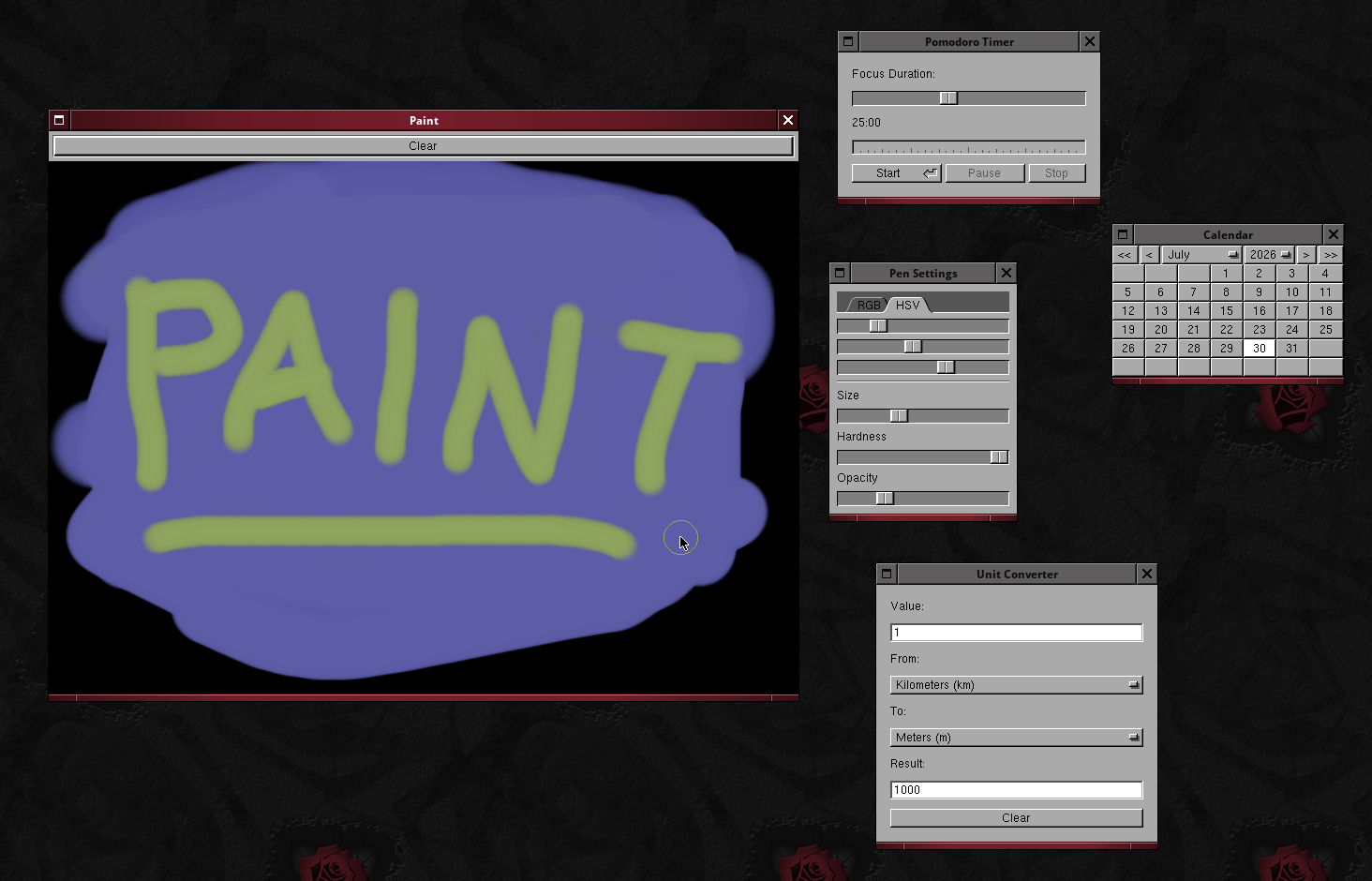
Then i asked it to just make a few small programs and it did[0] (the shot shows a paint app, a calendar, a todo list and a unit converter). Pretty much every program found bugs in the library :-P and gave me ideas on how to improve things.
In general i get the impression that LLMs aren't great at architecting things but if you do the architecture yourself and write them a framework to use, they should do a fine job at it.
[0] http://runtimeterror.com/pages/iv/images/d50c436990db203a07f...