My family runs a blood analysis lab in Belgium for which I wrote some of the statistics gathering software.
The thresholds for 25-OH vitamin D: <20 ng/mL → deficient, 20–30 ng/mL → insufficient.
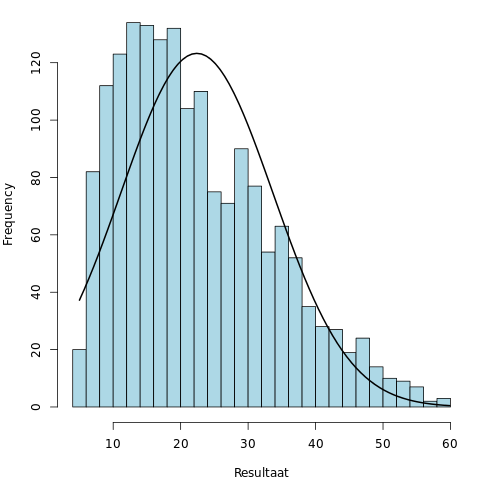
When I looked at all 1738 blood samples that had their Vitamin D tested between Feb 1, 2020 and Mar 13, 2020 (We were looking into the link between Vitamin D and COVID-19): The median (P50) was 20.1 ng/mL and the average was 22.4 ng/mL. Standard deviation: 11.24 ng/mL Half the samples were deficient, and the next 20% was insufficient.
Coming out of winter in Europe in a country with limited sunshine: most of the population is deficient in Vitamin D.
Histogram: https://files.catbox.moe/p785wx.png
Worth noting all the three big studies mentioned in the article were on Americans.
The last of the three was done on Australians. Not that it changes your point, given the latitude of Australia.
The curve on your diagram makes me think that you've fitted a normal (Gaussian) curve to the data. By eye, the distribution looks a bit more like log-normal, and so if you're still working on the data, you might want to try that to see. Not that anything you've said or concluded seems wrong, though.
The normal curve in the image is there for operators to visually check if the machine results are normal distributed or not. It's a "stencil", not data.
The software actually does a Lilliefors normality test which returns a big No on this data.
Ah, thanks for the information.
What do you think about the thresholds themselves? How often are they updated usually with new research?
Based on what I've seen while researching the topic for my own health purposes: the thresholds differ in various sources, but in general research appears to suggest that they may tend to err on the too low side rather than too high (there's quite a lot of headroom between what's often considered excessive and what's actually known to be toxic, while the lower end is much fuzzier).
I'm an engineer, not a clinical biologist or researcher. I have no idea.
On a personal level: I used to struggle with "winter dip". Taking Vitamin D supplements, as well as moving to South Africa, has both improved it a lot