Collectively (as in, the collective action problem):
- Areas with few/no cars are nicer to be in. To breathe, to talk quietly and hear others talking, to walk around safely.
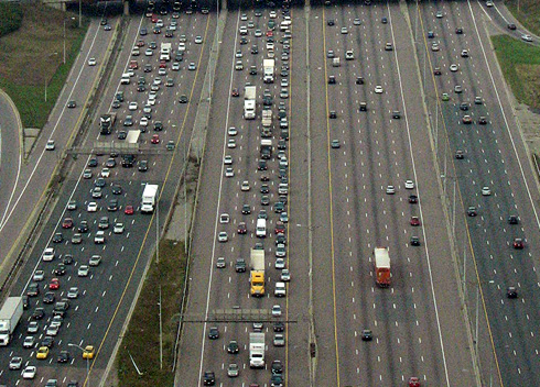
- Transport moves more people in less space and less overall investment. Toronto Highway 401[1] is an eighteen lane road and it moves fewer people per day than Metro line 1.
- Low car areas are better for local economies. People object to reducing traffic saying it will hurt local businesses, and the opposite is true. Where it's nice to exist outside of a car, that attracts people, and local businesses thrive.
- Reduced costs on health services from reduced pollution. Fewer doctor and hospital visits and prescriptions, for lung infections, breathing problems, asthsma and COPD in London after Low Emissions zones.
- Reduced environmental impact of fewer cars, fewer trips taken by car.
- Many people can't drive; all children, many injured or disabled people, many poorer people, many elderly people (can't or shouldn't), some people with e.g. DUI convictions. Some 20% of households in the UK have no access to a car. A matter of fairness and not prioritising the wealthy car owner.
Personally:
- No need to find parking, return to that carpark.
- Transit is more spacious. Being strapped into a carseat, elbows hitting doors, head hitting roof, knees hitting steering wheel, shins hitting dash, feet constrained in footwell, surrounded by explosives "for your protection" is a really unpleasant place to be.
- Less concentration needed. Driving requires constant attention. Even when transit is crowded, you don't have to do anything.
- Implemented well, transit takes priority over cars at turnings, crossings, junctions, roundabouts, and moves faster. Toronto trams do this especially poorly, apparently.
- Freedom. No need for a government approved license and ID. Not beholden to dragging a ton of steel boat-anchor around everywhere with you.
[1] https://3.bp.blogspot.com/-IRDiOiNYl9s/UEwAA79O2NI/AAAAAAAAG...
You describe some of the best possible transit scenarios and compare it to the worst possible car scenarios. That can easily be flipped.
My daily experience with transit is that you're far more likely to be standing, jam packed like sardines with your nose up someone's armpit. The train/bus is constantly heaving and shaking. You have to be always be concentrating not to stumble or fall into the person next to you.
This is a problem that still exists with some of the best transit systems, and is even more pronounced on the ones that aren't quite so nice.