Here's a real IBM 3270 keyboard.[1] Note the "Next field" key on the left, and the matching "Previous field" key on the right.
The IBM 3270 was a device for filling up forms. The mainframe sent the terminal a form with blanks, and the terminal let the user fill in the blanks. The terminal hardware prevented the user from overwriting the static parts of the form, and could apply some other form constraints, such as numeric fields. That was all done by the terminal. When the form was filled in, the user pressed ENTER, and the completed form was sent to the mainframe as one transaction. This approach let one mainframe service huge numbers of terminals. The user never experienced delays while typing and could type at full speed, often without looking.
PCs didn't have that usage model. The PC crowd was thinking "typewriter". One of the first terminals for home computers was called the "TV Typewriter".
Web forms do have that model, but with less consistency.
[1] https://sharktastica.co.uk/resources/images/model_bs/themk_1...
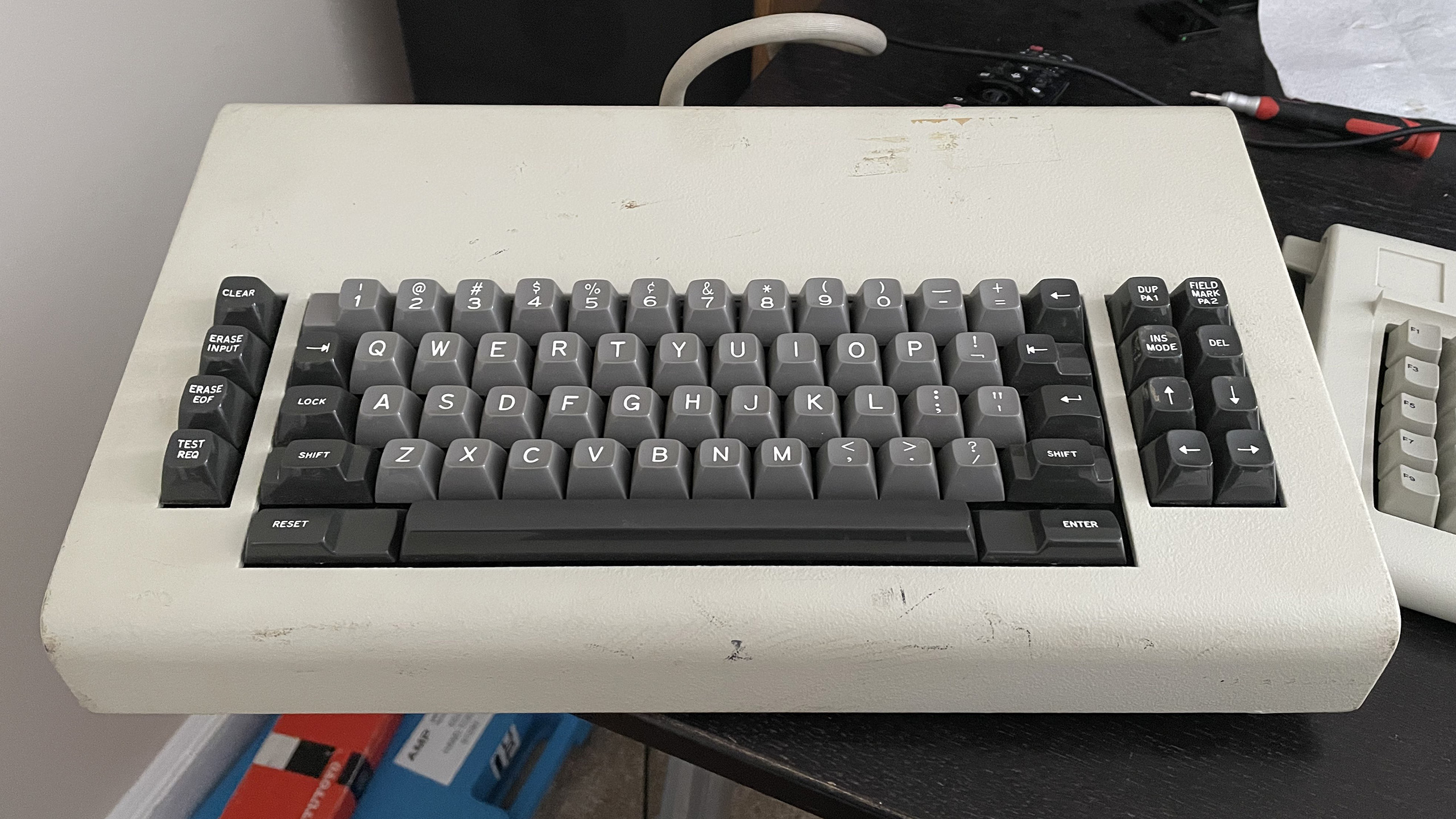
My favorite feature of 3270/5250-style keyboard layouts is the separate carriage return and Enter keys, allowing for multiline text entry without special handling to avoid conflicts with the command to signify that input is complete.
With only a single combined Enter/Return key, it's hard to remember in any given context whether Shift+Enter or Control+Enter will open up a new line instead of immediately sending a message, dismissing a dialog box, completing input into a particular spreadsheet cell, editable filename, text object in a drawing program, etc., or whether I need to copy/paste a line break from another application because no such shortcut exists at all.
The software I've used has been pretty consistent about Shift+Enter meaning "new line without triggering the Enter key action" and Ctrl+Enter meaning "action" (send the message, go to the next field, etc). The behavior of the Enter key varies from program to program, but I have yet to find a program where Shift+Enter triggered an action while Ctrl+Enter did not. Which software are you using where Shift+Enter triggers an action?
(I do agree that it's hard to remember what Enter is going to do, of course. It's just Shift+Enter where my experience differs from yours).
Yeah, the separate Enter and Return keys on Macs has always been nice.
The SAP application model is such a form-based model (no surprise given that all five co-founders of SAP were ex-IBM consultants that were fired for moonlighting - specifically, for writing a payroll software for chemical giant ICI in assembler on ICI's mainframe in an extended night action...).
SAP call their forms "dynpros" (dynamic programms), and the reslting interactive mode of processing "realtime/dialog programming" as opposed to "batch processing". This all looked very IBM 3270-"inspired" (and so was the SAP logo made up of IBM blue with the well-known stripes...).
Nitpick: The terminology used by IBM on the 3270 family (including the 3277 whose keyboard you shared) was "Tab" and "Back tab", not "Next field" and "Previous field".
Yes: Page 30 of The Operator's Guide for IBM 3270 Information Display Systems calls it a Tab key.
So my guess is that the cursor defaults to being at the start of a field as you navigate, so Tab and Back Tab work as expected. But if you're editing a field and have moved the cursor within the field then Back Tab acts differently.https://usermanual.wiki/Document/GA2727421OperatorsGuideforI...
This is correct. It's also worth pointing out that the 3270 defaults to overwrite rather than insert mode, and has an "Erase EOF" key that deletes all text from the cursor position to end-of-field.
Note as well that a screenful of user-entered checked/constrained text, meant for some form of database query or insert, meant just one interrupt to the mainframe CPU; and all the info was there in an easy to parse format. Very low use of resources.
It looks really strange to have 3 keys right next to each other all pointed in the same direction.
As another head scratcher, what is the shift-1 symbol? The exclamation point appears to be the shift next to one of the 3 left arrow keys, but I'm also unfamiliar with the regular unshifted key. Anyone familiar with these?
It's the | symbol.
On later generations of IBM terminal keyboard, you'll see | on the shift-1 position, and a separate key with the broken-bar (¦) symbol. For example, on this keyboard, the broken bar is below the backspace key along with the \ character. https://sharktastica.co.uk/image?id=qhTU8QvD
The reason for the two different types of bar/pipe characters, and why the original IBM PC keyboards only had the broken bar on the keyboard, involves a particularly arcane footnote of history relating to supporting the PL/I language on ASCII terminals: https://www.os2museum.com/wp/a-wunderbar-story/
I had never come across the broken bar before. I feel sorry for those that had to suffer these keys. The keyboard keys themselves look like they have about a mile of travel which was probably exhausting as well. I learned to type on clackity clackity arm typewriters, and those keys were I assumed designed by a masochist. These look even worse
The early 3270 keyboards (and the other IBM keyboards from the mid 70s up to the early 80s) are some of the most pleasant keyboards I've typed on in terms of key weighting and tactile feel. The length of travel is comparable to modern mechanical keyboards. The downside is how tall and aggressively angled the keyboards are, which are very far from modern ergonomic standards.
Those beam springs had the second-best feel ever, after the Selectric. Then the Model F cost-reduced (and thickness-reduced) it, and the Model M further.
> The downside is how tall and aggressively angled the keyboards are, which are very far from modern ergonomic standards.
Like a typewriter. And like a typewriter, you were expected to have them on suitable furniture so the keytops were at the right height.
Arrow keys are giving swastika vibes, which I guess fits given IBM’s history