I actually had to revisit this sort of thing in a recent design for a CNC --- for want of a good way to determine the location of a smaller circle nested into the region between two larger circles, I made a Circular Array of circles of the desired size, adjusting the number of them until one lined up as desired:
https://community.carbide3d.com/uploads/default/original/3X/...
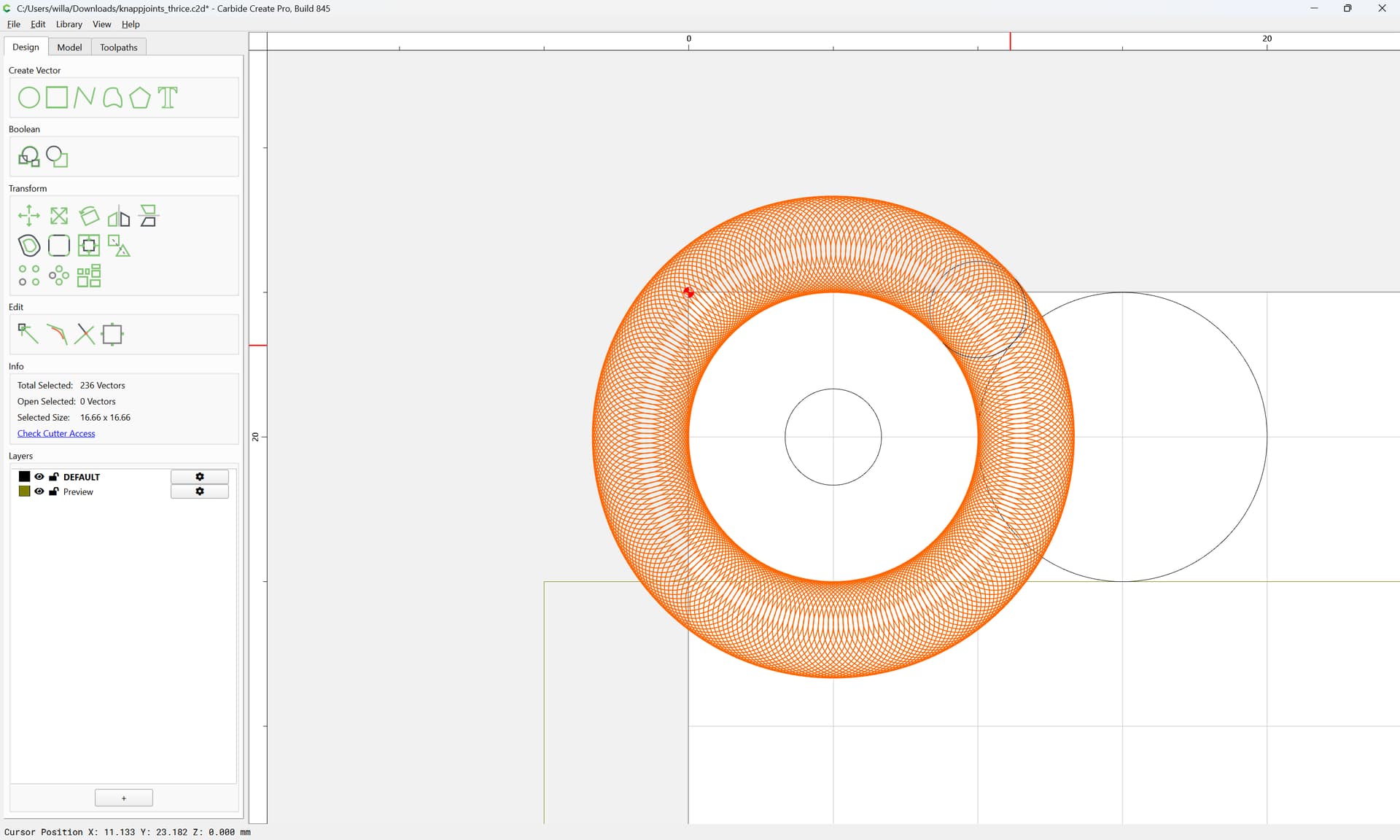
(If someone knows a good/ideal technique for that, I'd be glad to learn of it --- my math background is kind of shaky)
Let's give it a try.
I'm going to make two assumptions based on your screenshot:
1. The large circles A and B are touching each other
2. You know the radius (a,b,c) of each circle and want the third one (circle C) to touch both of the first two.
What I'd do is place the center of both circles A and B on the same horizontal line and choose a frame of reference such that the center of circle A is the origin, and the center of circle B is placed at coordinates (a+b, 0)
Now we are looking for the coordinates (x, y) of the center of circle C, placed above the x-axis. Which by the way is one of two solutions, as there is a symmetrical circle C' placed below the x-axis, with the coordinates (x, -y)
We know that if we traced a straight line from the center of C, it would intersect the x-axis at a 90° angle. So drawing that line creates two triangles which each have a right angle in this spot:
- one triangle on the left, where the hypothenuse goes from the center of A (0,0) to the center of C (x,y). Its length is the sum of the radii of A and C.
- one triangle on the right, where the hypothenuse goes from the center of B (a+b,0) to the center of C (x,y). Its length is the sum of the radii of B and C.
Both of these triangles share a vertical segment of length (y).
The left triangle's bottom segment has a length of (x) and the right triangle's bottom segment has a length of: (a+b) - x
We know from Pythagore that the square of the length of the hypothenuse is equal to the sum of the squares of the two sides of each triangle, so we know that:
So Develop it all Simplify and from there you find y, from y^2 = (a+c)^2 - x^2.I did notice that in your screenshot A and B are of the same size, so if you knew this from the start it becomes way simpler.
x = a (of course the center of your new circle is at the vertical of the point where both circles touch, which is obvious due to the symmetry of the problem)
and
y = squareroot(c^2 + 2ac)
Thank you for that!
I am going to make a link to your comment from the forum post in question:
https://community.carbide3d.com/t/knapp-joint-with-cnc/19723 (scroll all the way to the bottom)
and will hopefully be able to translate that into Open(Python)SCAD code so as to make a generalized solution for my current project:
https://github.com/WillAdams/gcodepreview